5th European Summer School on Electrochemical Engineering
(report prepared by Prof. Manuel Rodrigo)
The 5th European Summer School on Electrochemical Engineering took place in Almagro, a small town at the south of Madrid (Spain) from September 6th to 11th, 2009. A total number of eighty seven students attended to the school coming from a large number of European countries and also from Latin America.
The list of lecturers was of a very high quality including Prof. S. Bebelis (U. Patras, Greece), Prof. A. Katsaounis (Technical University of Crete, Greece), Prof. G. Kelsall (Imperial College, UK), Prof. V. Stankovic (U. Belgrade, Serbia). Prof. A. Cornell (KTH, Sweden), Prof. K. Bouzek (Institute of Chemical Technology, Czech Republic), Prof. Ch. Comninellis (EPFL, Switzerland), Prof. F. Walsh (U. Southampton, UK), Prof. A. Bergel (CNRS & U. Toulouse, France). Prof. J. M. Ortiz (U. Alicante, Spain) and Prof. P. Lavela (U. Cordoba, Spain). All of them kindly accepted the invitation and prepared excellent lectures. The more significant topics in electrochemical engineering were covered during the teaching sessions, ranging from fundamentals to microbial fuel cells, and also including electrochemical cell design, industrial and environmental applications and fuel cell technology. Impressions from the Sommer School
Detailed programme:
- Welcome lecture: Introduction to Electrochemical Engineering. Prof. Velizar Stankovic
- Electrochemical Thermodynamic and Kinetics. Prof. Symeon Bebelis
- NEMCA. Applications in environmental engineering. Prof. Alexandros Katsaounis
- Electrochemical Reactor Engineering. Prof. Ann Cornel
- Membranes. Application to separation processes. Prof. Karel Bouzek
- Modelling, simulation and design of electrochemical reactors. A practical case.Prof. Karel Bouzek
- Fundamentals of energy conversion systems. Batteries. Prof. Pedro Lavela
- Electrolysers and connection of electrochemical cells to renewable energy. Prof. Antonio Aldaz
- Fuel cell technology. The PEM and SO Fuel Cells. Prof. Frank Walsh
- Environmental applications of electrochemical engineering. Prof. Christos Comninellis
- Industrial electrosynthesis. Prof. Frank Walsh
- Energy efficiencies of electrochemical processes. Prof. Geoff Kelsal
- Biolectrochemical engineering. Microbiological fuel cells. Prof. Alain Bergel
Students also had the opportunity to discuss their research results during scientific workshop sessions, specially designed to promote discussion. Both, the lectures and a summary of the research results of students, were included in a book entitled "Electrochemical Engineering: Industrial, Energy and Environmental Applications" (ISBN 978-84-934398-6-6), specially edited and printed for the event.
The academic program was complemented by a very intense social program which included guide visit to Almagro and Toledo, visit to industrial facilities, magician show, concert and gala dinner.
Several moments of the 5th Summer School on Electrochemical Engineering
A questionnaire was distributed to the students in order to know more details about the strong/weak point of the school. The main results are summarised in the following listing (rate: maximum 5.00)
- Quality of organization: 4.79
- Teaching programme content 4.35
- Quality of teaching 4.46
- Quality of poster workshop 4.19
- Venue/Quality of teaching facilities 4.58
- Quality of accommodation 4.44
- Quality of social program 4.71
- Quality of other facilities (WiFi, etc.) 4.02
In general, the results were very satisfactory. The support of the Spanish Government, Re-gional Government, University of Castilla La Mancha, International Society of Electrochemistry and a large number of companies has been very important to obtain these good results.
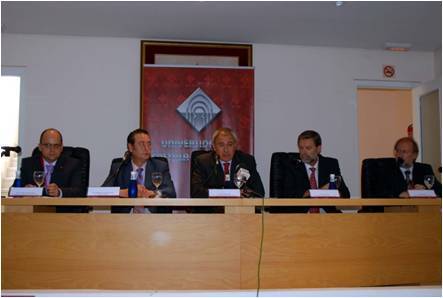
Opening Ceremony of the 5th ESSEE
From left to right: Prof. M. Rodrigo, the Rector of UCLM,
the Vice Chancellor of Research and Innovation of the Regional
Government, the Major of Almagro and Prof. S. Bebelis.
back to previous page